
Failure Isn’t the Problem. Misalignment Is.
Failure gets a bad rap.
In business - and honestly, in life - I've realized we treat it like a verdict instead of what it usually is: a signal of misalignment.
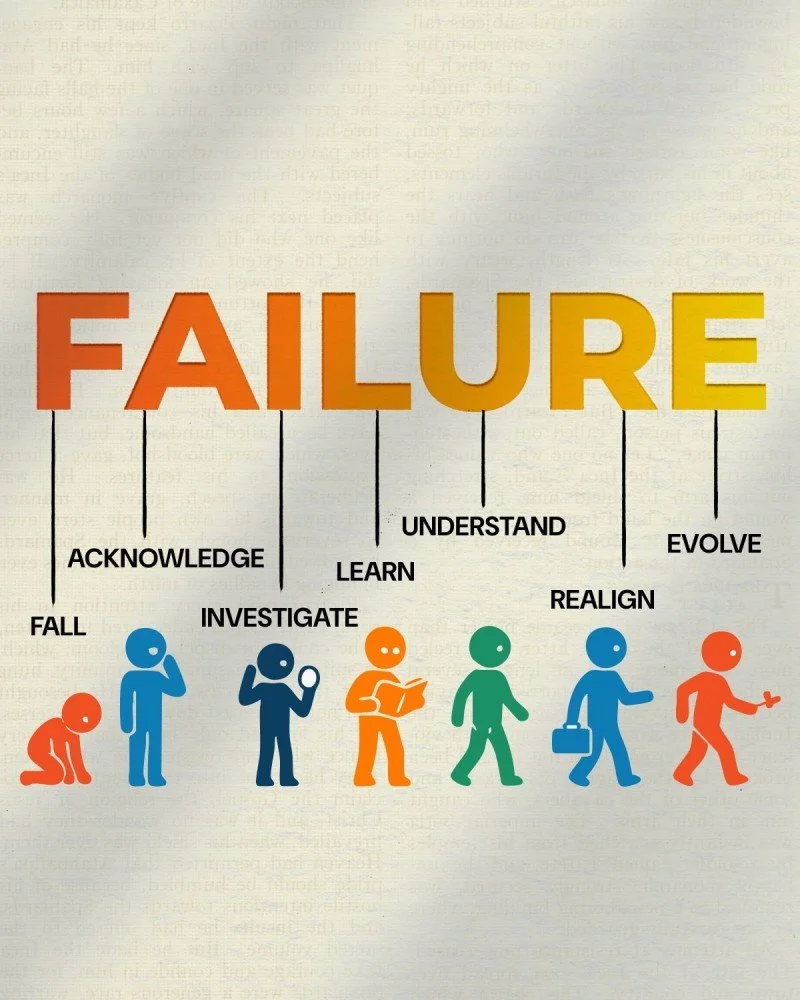
FAILURE acronym graphic - credit Alvin Huang
I've learned this the hard way. More than once.
Recently, I came across a visual framework created by Alvin Huang that reframes FAILURE not as an endpoint but as a strategic progression:
F – Fall A – Acknowledge I – Investigate L – Learn U – Understand R – Realign E – Evolve
The reason this framework hit home for me is simple: it mirrors how some of my biggest professional and personal growth moments actually unfolded - whether I recognized it at the time or not.
This isn’t motivational poster talk. It’s a practical operating system for diagnosing and correcting misalignment.
F – Fall (It Happens. Period.)
Professionally: A campaign underperforms. A project misses deadlines. A client relationship shifts.
Personally, failing has looked like burnout for me. Ignoring my body. Saying yes when I should have said no. Missing milestones I promised myself I'd reach.
Some of my biggest “falls” didn’t look dramatic from the outside. On paper, things looked fine. But internally? Something felt off. That disconnect - the quiet, underlying tension between effort and outcome - was the real signal.
The fall is inevitable. The real issue is not that you fell; it’s that you assumed alignment where none existed.
A – Acknowledge (Without Ego)
This is the moment most teams - and individuals (including myself) rush past or skip.
Professionally, it means saying:
“This didn’t land the way we thought.”
“Our assumptions were off.”
"We're busy, but not effective."
Personally, it means admitting:
“I’m more stressed than I realized.”
"Pushing harder isn't fixing this."
“I'm exhausted, not unmotivated."
Honest acknowledgment doesn't mean you did something wrong. It means you're paying attention. Attention is the starting point of any real strategy - whether you're leading a team or leading yourself.
I – Investigate (To Diagnose, Not Blame)
This is where strategy earns its keep.
Professionally, ask:
"What actually happened?"
"Are we solving the right problem - or just the loudest one?"
"Where were we misaligned: expectations, metrics, timing, execution?"
"What assumptions did we not test?"
Personal investigation is quieter - and harder:
"What’s driving the behavior?"
"What patterns keep showing up?"
"What truths have you been avoiding?"
"What am I tolerating that's draining my energy?"
This is uncomfortable work, but investigation without defensiveness is a one of the most powerful skills you can develop.
L – Learn (Extract the Signal)
Failure always contains data. Some of my most valuable lessons didn't come from wins; they came from moments where something should have worked...but didn't.
That's where the learning lives: Not just what failed, but why. Not just what changed, but what I ignored.
Professionally, I ask:
Which assumptions proved false?
What constraints did we misjudge?
Personally, I reflect on:
Which triggers are recurring?
What belief or habit needs recalibration?
Learning is the bridge between experience and wisdom. Skip it, and you repeat the cycle.
U – Understand (Zoom Out)
Understanding is learning in context.
Professionally, this means realizing that not every problem needed a faster solution; some needed a different structure altogether.
Personally, it means recognizing that constant friction isn’t a personal flaw. It's a sign that something in my environment, expectations, or pace needs to change.
Understanding turns isolated moments into patterns. And patterns tell the truth.
At work:
Is this a one-time situation or part of a trend?
Where are the structural misalignments - across teams, tools, expectations?
In life:
How does this connect to your identity, energy, or priorities?
What patterns emerge over time?
If you don’t contextualize, you repeat.
R – Realign (This Is the Hard Part)
Realignment is where accountability meets action.
Professionally, that might mean:
Shifting priorities
Resetting success metrics
Restructuring workflow
Personally, it may look like:
Adjusting habits
Changing environments
Revisiting boundaries or values
Realignment is uncomfortable because it requires action - not just insight. But it’s where momentum returns.
E – Evolve (The Payoff)
When failure is fully processed, you don’t just recover - you grow and move forward with clarity and intention. For me personally, this has resulted in trusting myself more, recognizing misalignment sooner, and stopping the habit of confusing struggle with progress.
For teams:
Better strategy
Sharper focus
Stronger decision-making muscle
For individuals:
Greater self-awareness
More consistent behavior
Enhanced resilience
Evolution isn’t a bonus - it’s the natural outcome of working through misalignment.
🔥 Final Spark
Failure doesn’t derail you.
Unexamined misalignment does.
When you rush past failure - either at work or in life - you miss the real opportunity: recalibration. To realign. To evolve.
Alvin Huang’s framework reminds us that failure isn’t a label. It’s a sequence. And every step matters.
So before you ask, “How do I avoid failure?” Try this instead:
“Where am I misaligned, and what am I willing to change?”
That’s where the real spark begins.
About the Author
Laura Martin builds marketing that actually performs - strategy first, systems second, tactics last. She’s a marketing strategist, business consultant, and project management professional with expertise across integrated media, digital advertising, and process optimization. Laura works at Mid-West Family Marketing & Media and leads Innovational Business Solutions, helping small business owners get organized, get visible, and get results through strategy, execution, and scalable systems.